
Glucometer: A Complete Guide to Checking Blood Sugar at Home
A glucometer, also called a blood glucose meter or blood sugar meter, is a small medical device used to measure the amount of glucose in a sample of blood.
For people who have diabetes, regular blood glucose monitoring can provide useful information about how food, physical activity, medicines, illness, stress and other factors affect blood sugar. Home monitoring can also help people and their healthcare teams make informed decisions about diabetes management.
However, simply owning a glucometer does not guarantee accurate results.
The way you wash your hands, the condition and storage of test strips, the amount of blood applied to the strip, the meter itself and even certain health conditions can affect the result.
This comprehensive guide explains what a glucometer is, how it works, how to use one correctly, what blood sugar readings mean, common testing mistakes, how to improve accuracy, how to choose a glucometer and when a reading requires medical attention.
Important: A home glucometer is a monitoring device. It should not be used by itself to diagnose diabetes. Diabetes diagnosis requires appropriate blood testing and interpretation by a healthcare professional.
Affiliate Disclosure:
This article may contain affiliate links. If you purchase through these links, we may earn a small commission at no extra cost to you. This helps support our website and allows us to continue creating free educational health content.
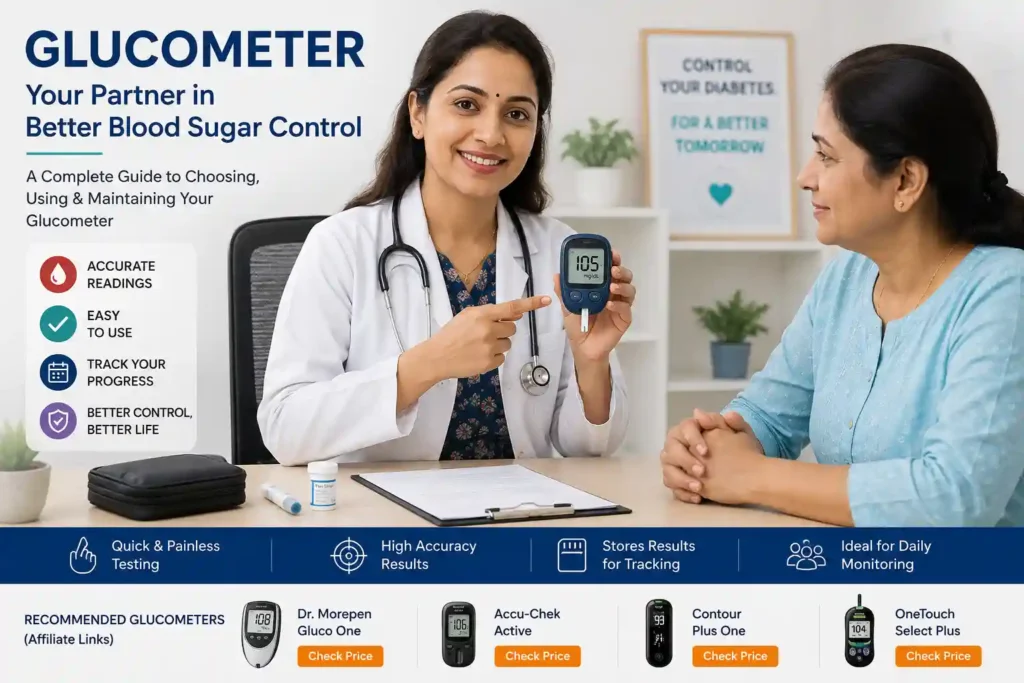
Table of Contents
What Is a Glucometer?
A glucometer is a portable device that measures glucose in a small blood sample, usually obtained by pricking a fingertip.
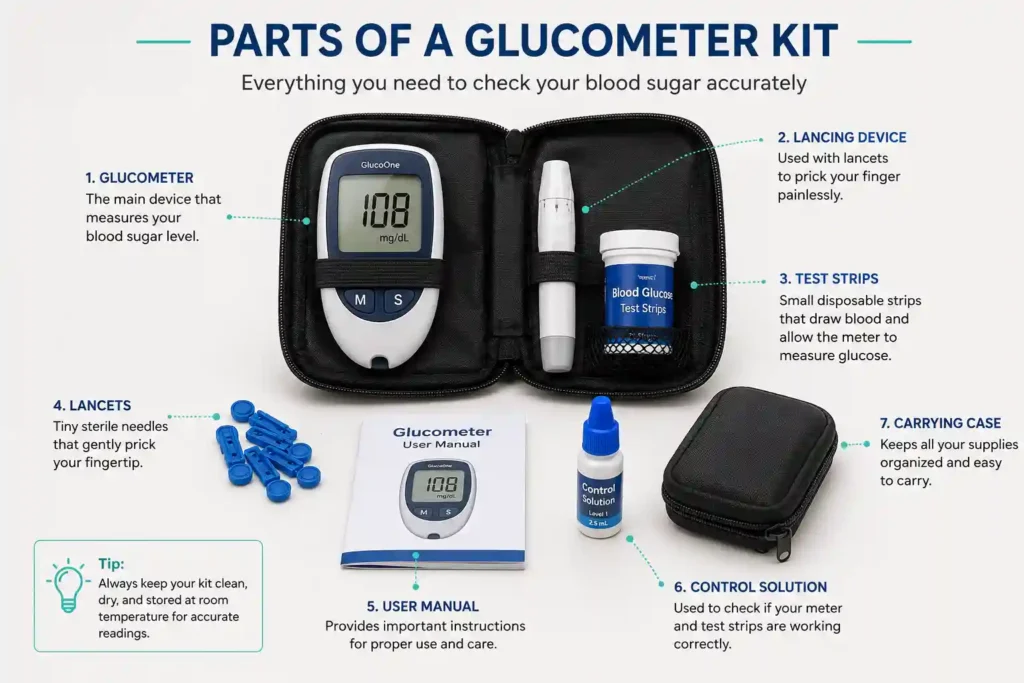
A typical blood glucose testing system includes:
- Glucose meter
- Test strips
- Lancing device
- Lancets
- Batteries or rechargeable power
- Carrying case
- Control solution, where applicable
- User instructions
The meter measures the glucose in the blood sample and displays a numerical result, commonly in mg/dL in India and many other countries.
Some modern meters can also store readings, calculate averages, connect to smartphone applications or transfer data for review.
The basic testing process remains similar: obtain a small blood sample, apply it to the appropriate test strip and allow the meter to measure the glucose level.
Looking for a glucometer for home use?
Before buying, compare the meter’s ease of use, test-strip availability, ongoing strip cost, display readability and data-storage features.
Why Is Blood Sugar Monitoring Important?
Blood glucose changes throughout the day.
Meals, exercise, medicines, stress, illness, sleep and many other factors can influence glucose levels.
For people with diabetes, recording glucose readings can help reveal patterns that may otherwise be difficult to notice.
For example, a person may discover that their glucose tends to:
- Rise significantly after certain meals
- Fall after exercise
- Change during illness
- Become low after certain diabetes medicines
- Be higher in the morning
- Vary considerably from day to day
Home monitoring can therefore provide useful information to the person and their healthcare team.
However, more testing is not automatically better for everyone. How often you should test depends on your diabetes type, treatment, medicines, risk of hypoglycemia and healthcare professional’s recommendations.
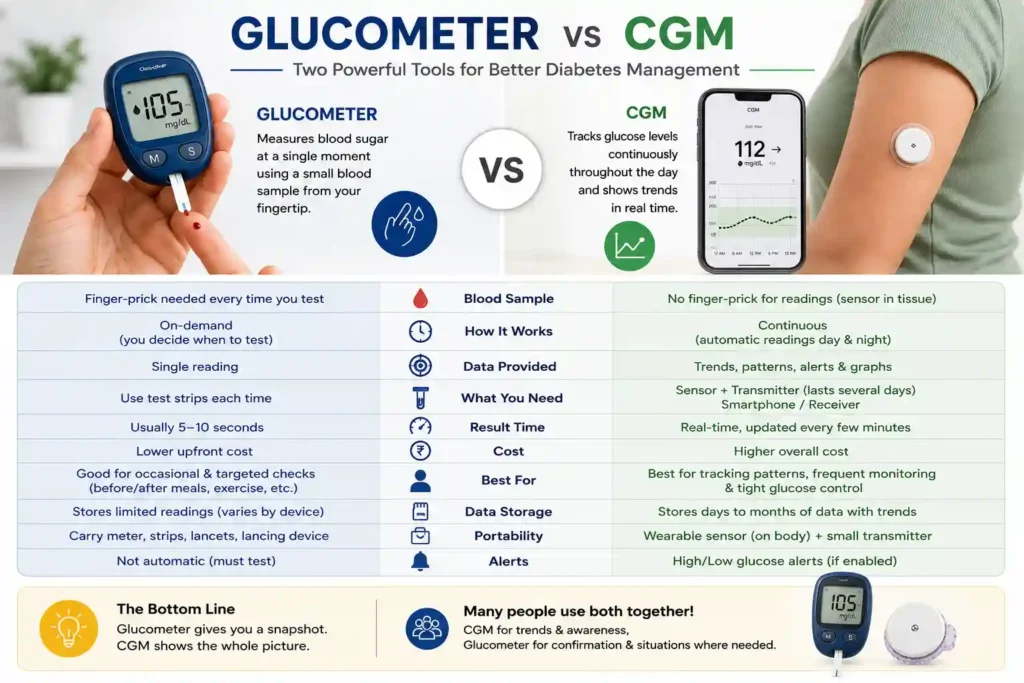
Glucometer vs. Continuous Glucose Monitor (CGM)
A glucometer and a continuous glucose monitor are not the same device.
| Feature | Glucometer | CGM |
|---|---|---|
| Sample | Small blood sample | Sensor measuring glucose in tissue fluid |
| Testing | Individual finger-stick measurements | Provides repeated readings throughout the day |
| Needles | Lancet for finger prick | Sensor inserted under the skin |
| Result | Usually available within seconds | Ongoing readings and trends |
| Data | Individual readings | Trends, graphs and alerts on compatible systems |
| Cost | Generally lower | Usually higher |
| Best use | Spot checks | Continuous monitoring |
CGM technology can provide considerably more information about glucose trends, but people using CGM may still need access to a conventional blood glucose meter in certain circumstances.
The appropriate device depends on the person’s medical needs, treatment, preferences and healthcare advice.
Looking for a CGM?
CGM can provide considerably more information about blood glucose trends.
How Does a Glucometer Work?
Although different brands use different technologies, the general process is straightforward.
- A test strip is inserted into the meter.
- A small blood sample is obtained using a lancet.
- The blood is applied to the test strip.
- The meter analyzes the sample.
- The glucose concentration is displayed on the screen.
The exact procedure, required blood volume and timing can differ between models, so always follow the manufacturer’s instructions.
What Do You Need to Check Blood Sugar?
Before testing, make sure you have:
- Glucometer
- Compatible test strips
- Lancing device
- New lancet
- Tissue or cotton
- A place to record the result
It is also useful to keep your testing supplies together so you don’t have to search for individual components every time.
How to Use a Glucometer Correctly
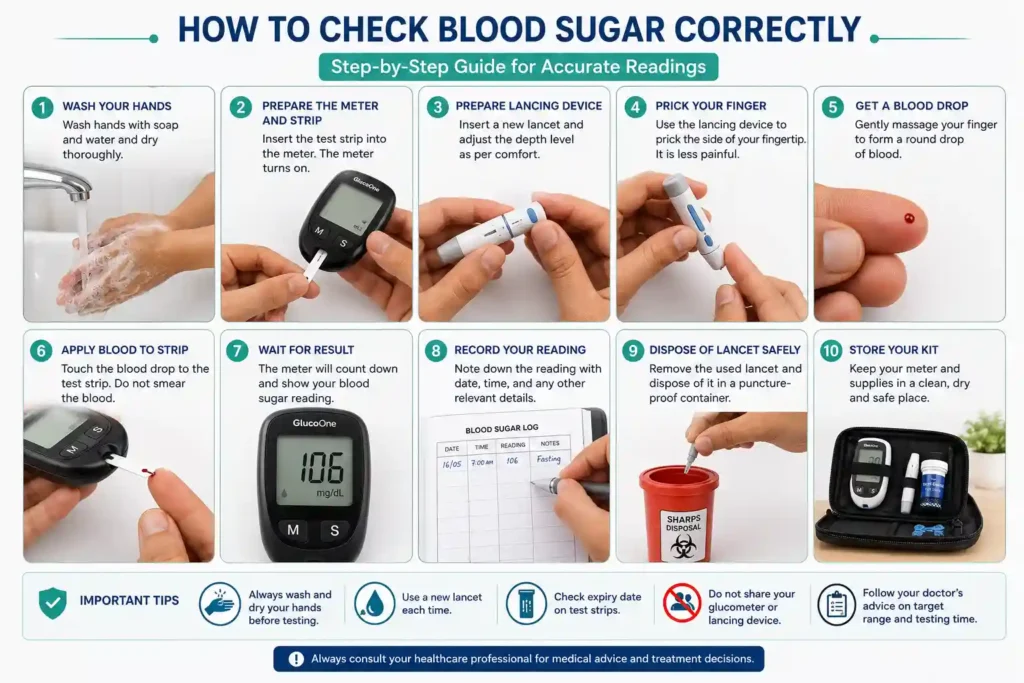
The following procedure applies generally to conventional finger-stick blood glucose meters. Always prioritize the instructions supplied with your particular device.
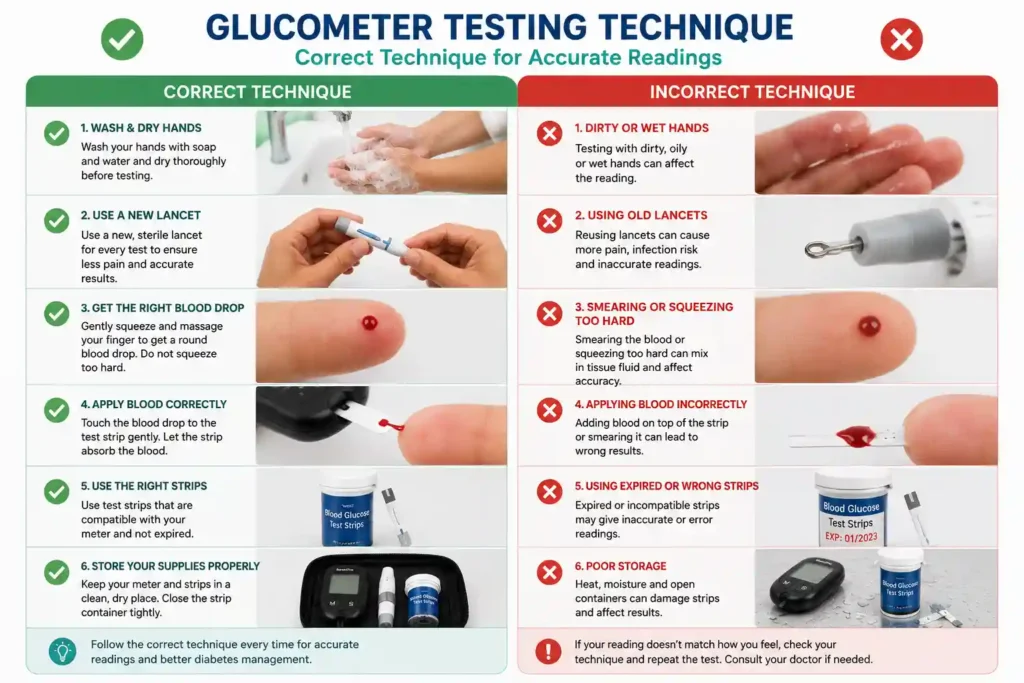
Step 1: Wash Your Hands
Wash your hands thoroughly with soap and water.
Dry them completely before testing.
This is one of the most important steps because substances on your fingers can affect the result. CDC guidance specifically recommends washing and drying your hands before every test.
Avoid testing with wet fingers.
Step 2: Prepare the Meter and Test Strip
Take a test strip from its container and close the container promptly if the manufacturer requires this.
Check:
- Expiry date
- Strip condition
- Compatibility with your meter
- Storage instructions
Do not use damaged or expired strips.
Test strips can be affected by moisture, temperature and improper storage.
Step 3: Insert the Test Strip
Insert the test strip into the meter according to the manufacturer’s instructions.
Many meters automatically turn on when the strip is inserted.
Wait until the meter indicates that it is ready for the blood sample.
Step 4: Prepare the Lancing Device
Insert a new lancet into the lancing device.
Adjust the depth according to the device instructions and your comfort.
Avoid using the same lancet repeatedly.
Step 5: Choose the Finger
The sides of the fingertip are often more comfortable than repeatedly pricking the central pad.
Rotate fingers and testing locations when appropriate to reduce soreness.
The American Diabetes Association notes that the side of the fingertip near the fingernail can help avoid repeatedly using the most sensitive part of the fingertip.
Step 6: Obtain a Blood Drop
Use the lancing device according to its instructions.
If necessary, gently massage the finger toward the fingertip.
Avoid excessive squeezing because technique can affect the sample.
Step 7: Apply Blood to the Test Strip
Touch the blood drop to the appropriate part of the test strip.
Make sure enough blood is applied according to the meter’s instructions.
Do not add additional blood to a strip unless the manufacturer specifically instructs you to do so.
Step 8: Wait for the Result
The meter will process the sample and display the glucose reading.
Do not immediately panic if the number is unexpected.
First consider whether:
- Your hands were clean and dry
- The strip was expired
- The strip was stored correctly
- Enough blood was applied
- The meter was used correctly
If the result does not match how you feel, repeat the test using correct technique and seek medical advice when appropriate.
Step 9: Record the Reading
Record:
- Date
- Time
- Glucose value
- Before or after food
- Relevant medication information
- Exercise
- Illness or unusual circumstances
Keeping a record can help identify patterns and gives your healthcare professional useful information.
Step 10: Dispose of the Lancet Safely
Do not leave used lancets where children or other people can accidentally touch them.
Follow local recommendations for disposal of used sharps.
When Should You Check Blood Sugar?
There is no single testing schedule that is appropriate for everyone.
Testing frequency depends on factors such as:
- Type of diabetes
- Whether insulin is being used
- Other diabetes medicines
- Risk of hypoglycemia
- Pregnancy
- Illness
- Exercise
- Individual treatment plan
Depending on the person’s treatment plan, healthcare professionals may recommend testing at times such as before meals, after meals, at bedtime, around exercise, when low blood sugar is suspected or when glucose is unexpectedly high.
Do not change your medication dose simply because of one glucometer reading unless your healthcare team has given you a specific plan for doing so.
What Is a Normal Blood Sugar Level?
This question requires caution because there is no single number that is “normal” for every person or situation.
For many nonpregnant adults Centers for Disease Control and Prevention (CDC) gives general targets of:
Fasting blood sugar test
This measures your blood sugar after an overnight fast (not eating).
- Normal: 109 mg/dL or below
- Prediabetes: 110–125 mg/dL
- Diabetes: 126 mg/dL or above
Glucose tolerance test
This measures your blood sugar before and after you drink a liquid that contains glucose. You’ll fast (not eat) overnight before the test and have your blood drawn to measure your fasting blood sugar level. Then you’ll drink the liquid and have your blood sugar level checked. These checks usually happen at 1 hour, 2 hours, and possibly 3 hours afterward.
At 2 hours:
- Normal: 139 mg/dL or below
- Prediabetes: 140–199 mg/dL
- Diabetes: 200 mg/dL or above
Random blood sugar test
This measures your blood sugar at the time you’re tested. You can take this test at any time and don’t need to fast (not eat) first.
- Normal: n/a
- Prediabetes: n/a
- Diabetes: 200 mg/dL or above
Individual targets may be different depending on age, health conditions, duration of diabetes, risk of hypoglycemia and other factors.
These targets should not be interpreted as a diagnostic test for diabetes.
A glucometer reading alone cannot establish whether someone has diabetes or prediabetes. Diagnosis requires appropriate laboratory testing.
Blood Sugar Unit Conversion: mg/dL and mmol/L
Some countries report glucose in mg/dL, while others use mmol/L.
The approximate conversion formulas are:
mg/dL → mmol/L
mg/dL ÷ 18 = mmol/L
mmol/L → mg/dL
mmol/L × 18 = mg/dL
For example:
108 mg/dL ÷ 18 = 6.0 mmol/L
Always check which unit your meter uses before interpreting the result.
What Can Cause an Inaccurate Glucometer Reading?
A glucometer reading can be affected by multiple factors.
1. Dirty Hands
Food, sugar and other substances on the fingers can interfere with the measurement.
Always wash and dry your hands before testing.
2. Wet Fingers
Water or other substances remaining on the skin can affect the blood sample.
Dry your hands thoroughly.
3. Expired Test Strips
Expired strips may not perform as intended.
Check the expiry date before use.
4. Incorrect Test Strips
Use strips specifically designed for your meter.
Do not assume that strips from one model will work with another.
5. Poor Storage
Test strips can be affected by moisture and environmental conditions.
Store them exactly as directed by the manufacturer.
6. Extreme Temperature
Very hot or very cold conditions can affect meter and strip performance.
Follow the manufacturer’s temperature recommendations.
7. Insufficient Blood
If the strip requires a particular sample volume, too little blood may cause an error or unreliable measurement.
8. Incorrect Technique
Not following the manufacturer’s instructions can produce unreliable results.
9. Health Conditions
Certain physiological conditions can interfere with glucose measurements. FDA guidance notes that factors affecting glucose results can include particular medical conditions and other circumstances.
10. Device or Strip Problems
If unusual readings continue despite correct testing technique, contact the manufacturer or healthcare professional.
How to Make Your Glucometer Readings More Accurate
Use this simple checklist:
- Wash hands with soap and water.
- Dry hands completely.
- Use an unexpired strip.
- Use the correct strip for your meter.
- Store strips according to instructions.
- Keep the meter clean.
- Use a new lancet.
- Follow the manufacturer’s instructions.
- Apply the correct amount of blood.
- Check unusual readings again.
- Do not share your glucose meter.
- Keep a record of readings.
- Discuss persistent unusual readings with your healthcare professional.
The FDA specifically recommends that personal blood glucose monitoring systems not be shared between people because of bloodborne infection risks.
Why Should You Not Share a Glucometer?
A glucometer may come into contact with blood.
Even if two family members have diabetes, sharing a device can create a potential infection risk.
The FDA recommends that over-the-counter blood glucose monitoring systems intended for personal use should not be shared between people.
If multiple family members monitor their glucose, each person should have appropriate equipment and follow proper infection-control practices.
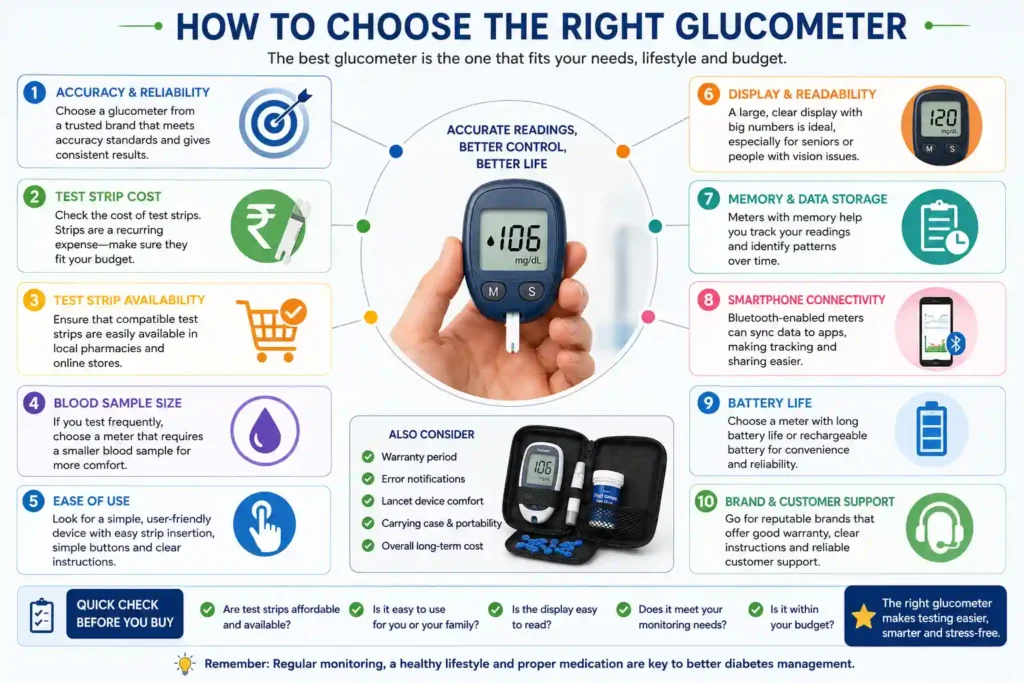
How to Choose the Best Glucometer
There is no universally “best” glucometer.
The best meter is one that is appropriate for the user’s needs, reliable, easy to operate and supported by readily available compatible supplies.
When comparing meters, consider:
1. Accuracy
Accuracy is one of the most important factors.
Look for a reputable device that complies with applicable regulatory and performance requirements.
The FDA advises users to consider meter quality and the quality of test strips when evaluating blood glucose monitoring systems.
2. Test-Strip Cost
This is frequently overlooked.
A meter may be inexpensive initially but expensive to use if its test strips cost more.
When comparing glucometers, calculate the long-term cost of strips, not just the price of the device.
3. Test-Strip Availability
A meter is not very useful if compatible strips are difficult to find.
Before buying, check whether strips are readily available through reputable pharmacies or authorized sellers.
4. Blood Sample Size
Some meters require only a small blood sample.
For people who test frequently, a smaller sample requirement may make testing more comfortable.
5. Screen Size
A large, easy-to-read screen can be particularly useful for older adults or people with vision difficulties.
6. Memory and Data Storage
Some meters can store previous readings.
This can make it easier to review glucose patterns.
7. Smartphone Connectivity
Some modern glucose meters can connect to apps.
This may be useful for people who want digital records or wish to share readings with their healthcare team.
8. Ease of Use
Consider:
- Strip insertion
- Button size
- Screen readability
- Error messages
- Blood application process
- Lancet adjustment
- Data storage
A device with fewer complicated steps may be more suitable for some users.
9. Customer Support
Choose a manufacturer that provides clear instructions and accessible customer support.
Mayo Clinic also recommends considering ease of use, data handling and manufacturer support when selecting a meter.
Affiliate Buying Guide: Glucometer Shopping Checklist
Before purchasing a glucometer, ask:
Does it have compatible strips that I can easily purchase?
Are the strips affordable over the long term?
Is the display easy for me to read?
Is the device simple enough for me or my caregiver to operate?
Does it store previous readings?
Does it offer useful connectivity features?
Does the manufacturer provide instructions and customer support?
Is the product legally marketed and appropriately regulated for my region?
Affiliate Product Links
Recommended shopping categories:
- Glucometer kits: View current options —
- Blood glucose test strips: View compatible strips —
- Lancets: View lancets —
- Lancing devices: View lancing devices —
- Diabetes storage/travel cases: View cases —
Editorial recommendation: Do not choose a glucometer solely because it is the cheapest. Consider the total cost of ownership, especially recurring test-strip costs.
Can a Glucometer Diagnose Diabetes?
No.
A home glucometer is useful for monitoring glucose but should not be used as the sole tool to diagnose diabetes.
According to the National Institute of Diabetes and Digestive and Kidney Diseases, diabetes diagnosis is based on appropriate blood tests, and over-the-counter blood glucose meters cannot diagnose diabetes.
If you suspect diabetes because of symptoms or risk factors, arrange appropriate testing with a healthcare professional.
Can a Glucometer Be Wrong?
Yes.
Modern glucose meters can provide useful readings when used correctly, but they are not perfect.
Incorrect readings can occur because of:
- Dirty hands
- Incorrect strips
- Expired strips
- Poor strip storage
- Temperature
- Incorrect technique
- Insufficient blood
- Device problems
- Certain health conditions
Mayo Clinic recommends repeating an unusual reading and checking technique, strips and equipment when results seem inconsistent.
What Should You Do If a Reading Seems Wrong?
If the reading seems inconsistent with how you feel:
- Wash and dry your hands.
- Use a new test strip.
- Repeat the test.
- Check that the strip is compatible and unexpired.
- Review the meter instructions.
- Consider whether anything unusual could have affected the result.
- Contact your healthcare professional if concerning readings persist.
If you have symptoms of severe hypoglycemia, severe hyperglycemia or another medical emergency, seek urgent medical care rather than repeatedly relying on home testing.
Should You Test Again If the Number Looks Unexpected?
Often, yes.
A single unexpected reading should be interpreted in context.
For example, if your result suddenly differs dramatically from your usual readings, first check whether the test was performed correctly.
However, do not ignore symptoms simply because a repeat reading looks better.
Likewise, do not delay emergency care while repeatedly testing yourself.
Glucometer Mistakes to Avoid
Here are some of the most common mistakes:
Mistake 1: Testing Without Washing Hands
Food residue can affect the reading.
Mistake 2: Using Expired Strips
Always check the expiry date.
Mistake 3: Leaving the Strip Container Open
Moisture can damage strips.
Mistake 4: Using the Wrong Strips
Use strips designed for your specific meter.
Mistake 5: Sharing the Device
Do not share personal blood glucose monitoring equipment.
Mistake 6: Changing Medication Based on One Reading
Medication adjustments should follow your healthcare professional’s plan.
Mistake 7: Assuming One Reading Diagnoses Diabetes
Diagnosis requires appropriate laboratory testing.
Mistake 8: Buying a Meter Without Checking Strip Prices
Recurring strip costs can exceed the initial device cost.
Mistake 9: Ignoring Symptoms
A glucose number should never be considered separately from how you feel.
Can Smartwatches Measure Blood Sugar Without a Finger Prick?
Be cautious about products that claim to measure blood glucose non-invasively simply by wearing a smartwatch or smart ring.
The FDA has warned consumers about unauthorized devices marketed as measuring blood glucose without piercing the skin. The agency advises against relying on such products for glucose measurement.
A smartwatch displaying glucose information from an authorized CGM is different from a smartwatch that independently claims to measure blood glucose without an appropriate glucose-sensing system.
Before buying a “non-invasive glucose monitor,” verify the device’s regulatory status and evidence rather than relying solely on advertising claims.
How Often Should You Replace a Glucometer?
There is no universal replacement interval that applies to every meter.
Consider replacing or evaluating the device when:
- It repeatedly produces questionable readings.
- The manufacturer recommends replacement.
- The device is damaged.
- The display or buttons stop working properly.
- It repeatedly produces unexplained errors.
- You can no longer obtain compatible strips.
- Your healthcare professional recommends another device.
Do not replace a meter simply because a newer model exists if your current device is functioning correctly and appropriate for your needs.
How to Store Your Glucometer and Test Strips
Good storage can help protect your testing supplies.
Keep the meter:
- Clean
- Dry
- Protected from extreme temperatures
- Away from excessive humidity
- In its case when traveling
Keep test strips:
- In their original container when required
- Properly sealed
- Dry
- Away from excessive heat and humidity
- Within their expiry date
Always follow the manufacturer’s storage instructions because requirements differ between products.
Don’t forget the recurring cost of test strips
The meter itself is only part of the cost. If you test regularly, compatible strips can become your biggest ongoing expense.
Glucometer Travel Tips
If you travel with diabetes-testing equipment, consider carrying:
- Glucometer
- Extra test strips
- Extra lancets
- Lancing device
- Batteries if required
- Medication
- Written or digital glucose records
- Healthcare contact information
Do not wait until you run out of strips before looking for replacements.
If traveling, carrying extra supplies can be especially useful because the exact compatible strips may not be readily available everywhere.
How to Keep a Blood Sugar Log
A useful blood glucose log can include:
| Date | Time | Glucose | Before/After Meal | Food | Exercise | Medication | Notes |
| Monday | 7:30 AM | Before breakfast | |||||
| Monday | 10:00 AM | After breakfast | |||||
| Monday | 2:00 PM | Before lunch | |||||
| Monday | 9:00 PM | Bedtime |
You do not necessarily need to record every category every time.
The goal is to create useful information that helps identify patterns and supports discussions with your healthcare team.
Glucometer FAQs
1. What is a glucometer?
A glucometer is a portable blood glucose meter that measures the amount of glucose in a small blood sample, usually obtained from a fingertip. It is commonly used by people with diabetes to monitor blood sugar at home. A glucometer can help track glucose levels but cannot by itself diagnose diabetes.
2. Is a glucometer the same as a blood sugar machine?
Yes. “Blood sugar machine,” “blood glucose meter,” “glucose meter” and “glucometer” are commonly used terms for devices that measure blood glucose.
3. Can a glucometer diagnose diabetes?
No. A home glucometer is intended for glucose monitoring and cannot by itself diagnose diabetes. Diagnosis requires appropriate blood testing.
4. What is a normal blood sugar reading?
There is no single number that applies to everyone. For many nonpregnant adults with diabetes, commonly used ADA targets are 80–130 mg/dL before meals and less than 180 mg/dL 1–2 hours after starting a meal, but individual targets vary.
5. Why is my glucometer giving different readings?
Glucose naturally changes over time, and testing technique, strips, temperature, storage and other factors can affect results.
6. Can I use expired test strips?
It is best not to use expired strips. Use strips within their stated expiration period and follow the manufacturer’s storage instructions.
7. Can two glucometers give different results?
Yes. Different meters may produce somewhat different readings, and home meters are not laboratory analyzers. If results seem repeatedly inconsistent with your symptoms or laboratory results, discuss the issue with your healthcare professional.
8. Should I wash my hands before checking blood sugar?
Yes. Washing and drying your hands before testing helps reduce the chance that substances on your fingers will affect the result.
9. Can I share my glucometer with another person?
No. Personal blood glucose monitoring systems should not be shared because of the risk of bloodborne infection.
10. How often should I check my blood sugar?
It depends on your diabetes type, medicines, insulin use, risk of hypoglycemia and treatment plan. Follow the schedule recommended by your healthcare professional.
11. Are expensive glucometers more accurate?
Price alone does not guarantee accuracy. Compare regulatory status, performance, test-strip quality, usability, availability and long-term cost.
12. Are smartphone-connected glucometers better?
Connectivity can make record keeping easier, but it is not essential for everyone. Choose features that genuinely help you manage your glucose data.
13. What is more important: the glucometer or test strips?
Both matter. A good meter is of limited value if compatible strips are unavailable, improperly stored or too expensive for regular use.
14. Can I check blood sugar from somewhere other than my fingertip?
Some meters permit alternative-site testing, but readings may be less suitable when glucose is changing rapidly. Follow your meter’s instructions and ask your healthcare professional if alternative-site testing is appropriate for you.
15. What should I do if my blood sugar reading is very high or very low?
Follow the personalized action plan provided by your healthcare professional. If the reading is unexpected, repeat the test using correct technique when appropriate. If you have severe symptoms, confusion, unconsciousness, seizures, difficulty breathing or another emergency warning sign, seek urgent medical care.
Final Takeaway
A glucometer can be a valuable tool for people who need to monitor blood glucose at home.
But getting a number on the screen is only the beginning.
For useful results, you need to:
- Use the meter correctly.
- Wash and dry your hands before testing.
- Use compatible, unexpired test strips.
- Store strips properly.
- Avoid sharing the meter.
- Record readings when recommended.
- Look for patterns rather than reacting to one number.
- Understand that personal glucose targets vary.
- Never use a home glucometer alone to diagnose diabetes.
- Discuss persistent unusual readings with your healthcare professional.
When choosing a glucometer, don’t focus only on the purchase price. Consider accuracy, ease of use, strip availability, recurring strip cost, data features, readability and manufacturer support.
A simple, reliable system that you can use correctly and consistently is often more valuable than a complicated device with features you will never use.
Need everything in one kit?
A complete blood glucose testing kit may include the meter, test strips, lancing device and lancets.
Medical Disclaimer
This article is for educational and informational purposes only and is not a substitute for professional medical advice, diagnosis or treatment. Blood glucose targets vary between individuals. Do not start, stop or change diabetes medicines or insulin based solely on information in this article or on a single glucometer reading. If you have concerning symptoms or an emergency, seek appropriate medical care. Always follow the instructions supplied with your glucose meter and test strips and consult your healthcare professional for personalized advice.
Read also – Digital Thermometer: Types, Uses, Accuracy, Buying Guide & Best Picks.