
Weighing Scale: The Complete Guide to Choosing, Using and Checking Your Weight Accurately at Home
Table of Contents
Quick Answer
A weighing scale is a device used to measure body weight. A good-quality digital weighing scale can be a useful tool for monitoring weight at home, particularly when measurements are taken under similar conditions each time.
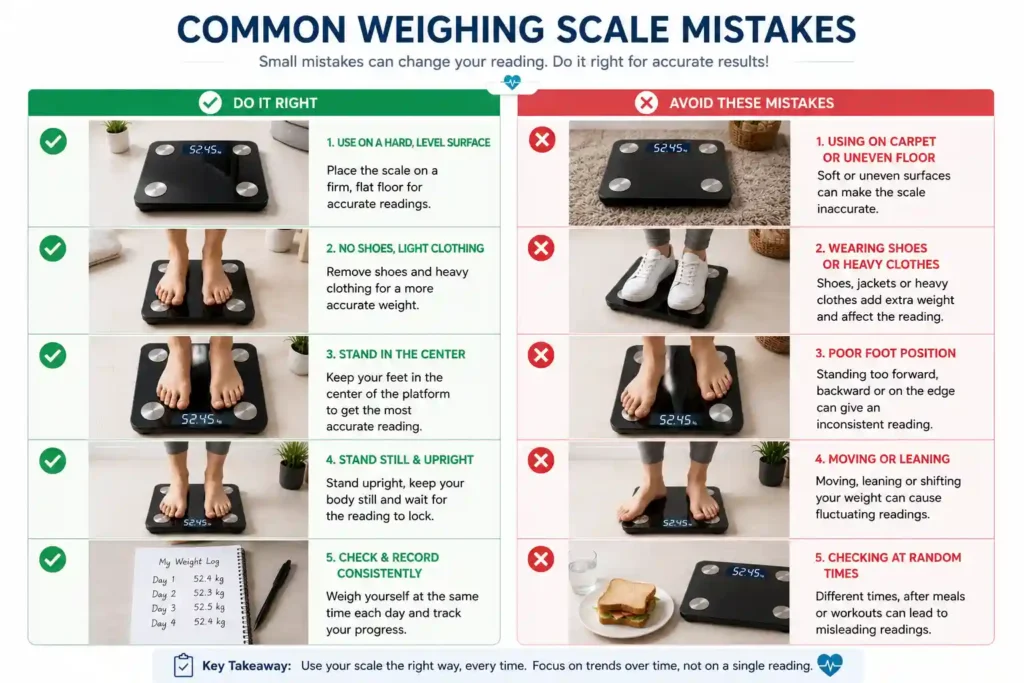
For the most consistent results, place the scale on a hard, level floor, measure without shoes and heavy clothing, stand still in the center of the scale, and try to weigh yourself at approximately the same time and under similar conditions.
However, your weight is only one part of your overall health. A weighing scale cannot diagnose obesity, malnutrition, or a medical condition by itself. Weight should be considered alongside factors such as height, waist circumference, medical history, symptoms, diet, physical activity, and other health measurements.
Affiliate Disclosure:
This article may contain affiliate links. If you purchase a product through one of these links, we may receive a commission at no additional cost to you. We recommend products based on their features and usefulness; however, prices, availability, specifications, and offers can change.
What Is a Weighing Scale?
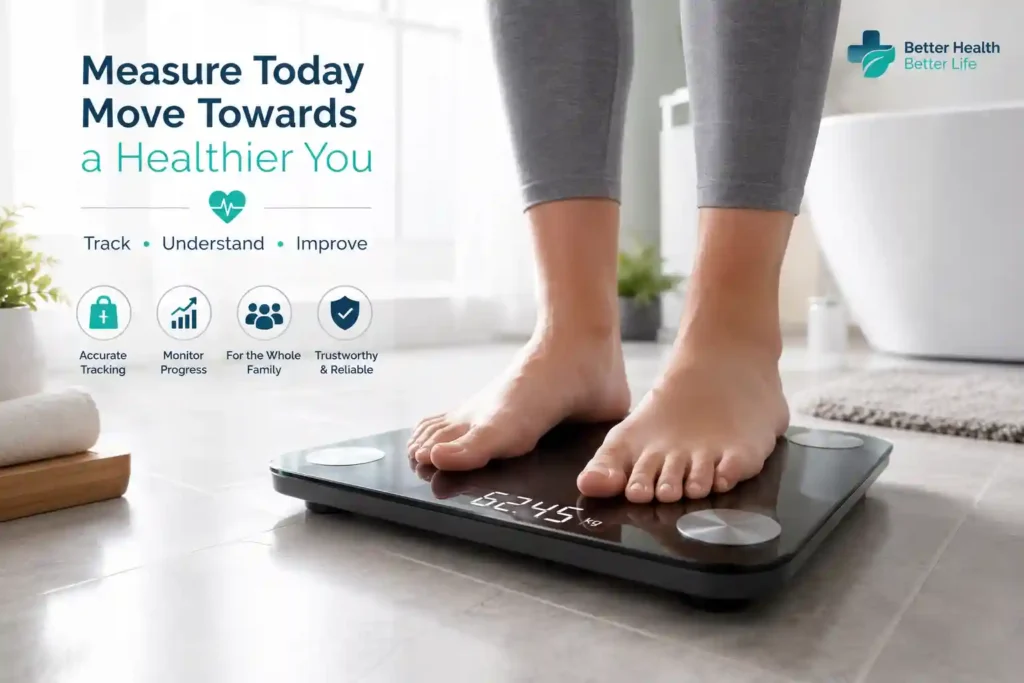
A weighing scale is a device designed to measure the weight or mass of an object. When used for people, it is commonly called a body weighing scale, bathroom scale, weight machine, or personal weighing scale.
Modern home scales are generally digital. They use sensors to detect the force exerted by your body and display the measurement electronically, usually in kilograms (kg) or pounds (lb).
Some newer models, known as smart weighing scales, can connect to a smartphone and may provide additional measurements or tracking features.
Important: Additional measurements provided by smart scales, such as body-fat percentage, muscle mass, water percentage, or visceral-fat estimates, should not automatically be treated as medical diagnoses. They are estimates generated by the device.
Why Is a Weighing Scale Useful at Home?
A home weighing scale can help you monitor changes in body weight over time.
Regular monitoring may be useful for people who are:
- Trying to lose weight
- Trying to gain weight
- Following a nutrition or exercise program
- Monitoring weight during lifestyle changes
- Tracking general fitness progress
- Monitoring children or older adults when appropriate
- Following a healthcare professional’s weight-monitoring advice
The most useful information is often the trend over time, rather than a single reading.
For example, a difference of several hundred grams from one day to another does not necessarily mean that you gained or lost the same amount of body fat.
Body weight can naturally fluctuate because of:
- Fluid retention
- Food and drink consumed
- Bowel movements
- Salt intake
- Carbohydrate intake
- Exercise
- Hormonal changes
- Time of day
- Clothing
Therefore, comparing measurements taken under similar conditions provides more useful information.
Types of Weighing Scales
Not every weighing scale is designed for the same purpose.
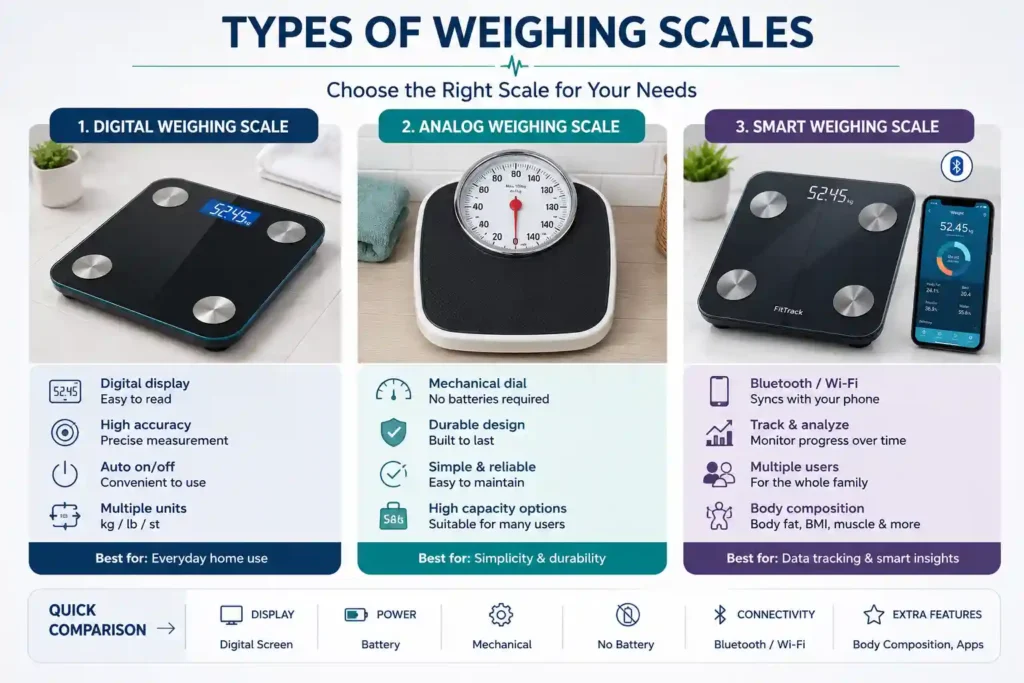
1. Digital Weighing Scale
A digital scale displays your weight electronically, usually on an LCD or LED screen.
Advantages
- Easy to read
- Usually compact
- Convenient for home use
- Often provides measurements in kg and lb
- Many models automatically turn on and off
- Generally easy to clean
For most households, a basic digital weighing scale is sufficient for routine weight monitoring.
2. Analog Weighing Scale
Analog scales use a mechanical mechanism and a dial or pointer to indicate weight.
They can work without batteries, but reading the measurement may be more difficult than reading a digital display.
For people who prefer simplicity and do not want to replace batteries, an analog model may still be an option.
3. Smart Weighing Scale
Smart scales can connect to smartphones using technologies such as Bluetooth or Wi-Fi.
Depending on the model, they may offer:
- Weight tracking
- Multiple user profiles
- Smartphone synchronization
- Weight history
- BMI calculation
- Body-fat estimates
- Muscle-mass estimates
- Water-percentage estimates
- Graphs and trends
These features can be convenient if you enjoy tracking health data digitally.
However, more features do not automatically mean greater accuracy.
Digital vs Smart Weighing Scale: Which Is Better?
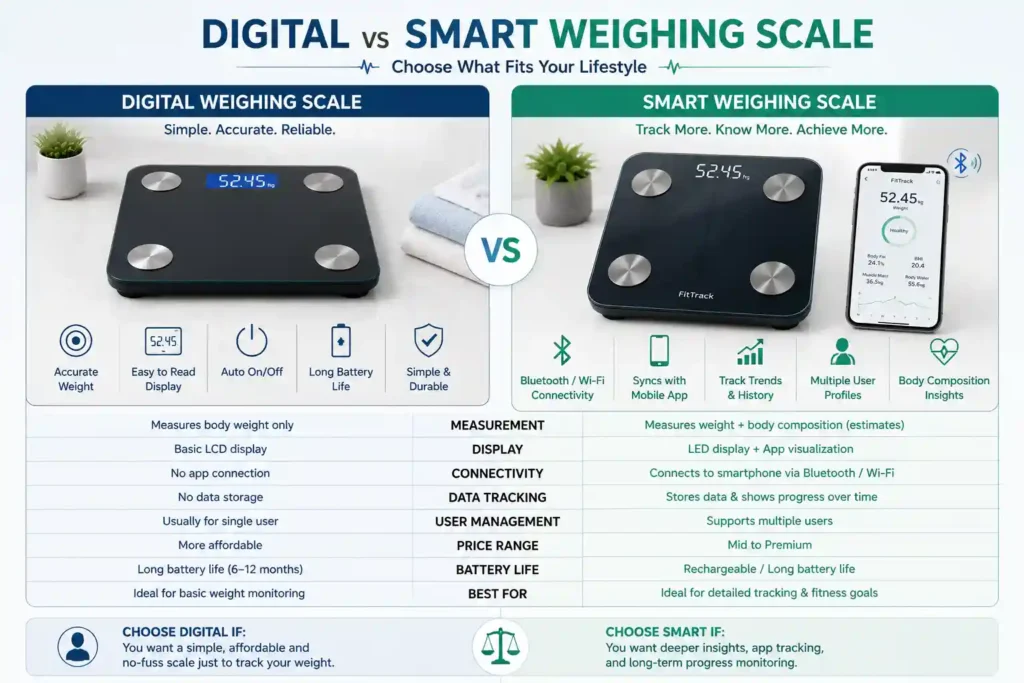
The right choice depends on your needs.
| Feature | Basic Digital Scale | Smart Scale |
|---|---|---|
| Weight measurement | Yes | Yes |
| Easy display | Yes | Yes |
| Smartphone tracking | Usually no | Usually yes |
| Multiple users | Some models | Common |
| BMI calculation | Some models | Common |
| Body composition estimates | Usually no | Often |
| Simplicity | Excellent | Moderate |
| Best for | Basic monitoring | Data tracking |
If your only goal is to monitor body weight, a simple, reliable digital scale may be all you need.
If you enjoy tracking trends through an app, a smart scale may be more convenient.
How to Choose the Best Weighing Scale for Home
Buying the most expensive weighing scale is not necessarily the best approach.
Instead, look for features that match your actual needs.
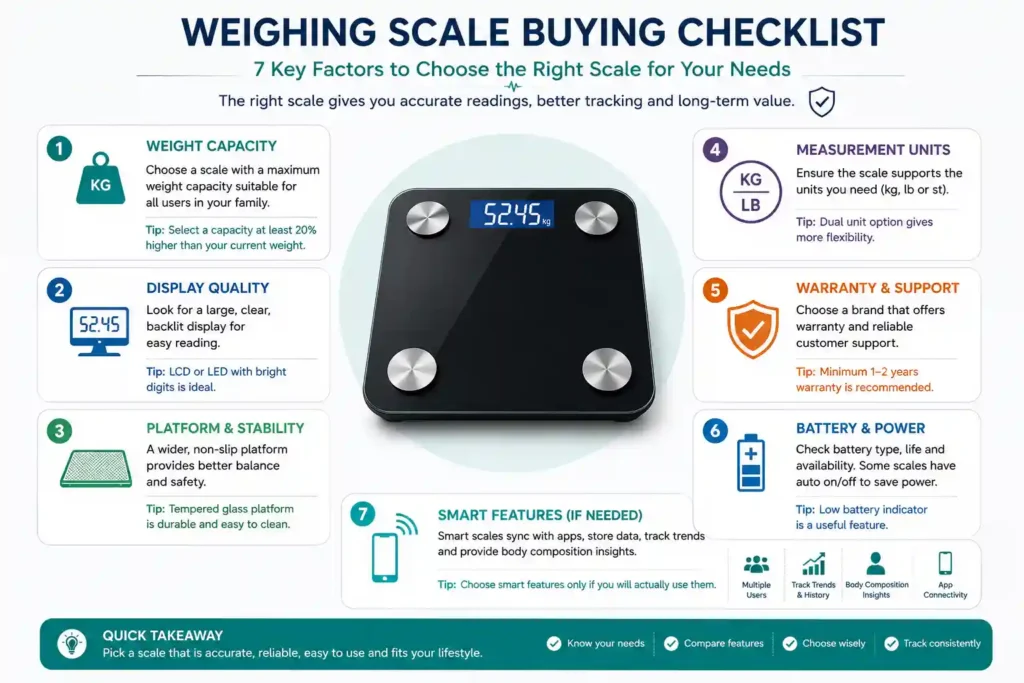
1. Check the Maximum Weight Capacity
Always check the manufacturer’s stated maximum capacity.
A scale should have a suitable weight capacity for everyone who will use it.
Never exceed the manufacturer’s specified limit.
2. Look for a Stable Platform
A wider platform can make standing on the scale more comfortable and stable.
This can be particularly important for older adults or people who have difficulty maintaining balance.
If balance is a concern, consider discussing safer weighing methods with a healthcare professional.
3. Choose a Clear Display
A large, high-contrast display can make readings easier to see.
Some scales have illuminated displays, which can be useful in bathrooms or rooms with low lighting.
4. Check Measurement Units
Choose a scale that supports the unit you commonly use.
Most models provide kilograms, pounds, or both.
For routine health records, kilograms are commonly used in medical settings.
5. Consider the Scale’s Resolution
Some scales display measurements to the nearest 0.1 kg, while others may show finer increments.
A smaller displayed increment does not necessarily mean the scale is medically more accurate.
Look for information about the manufacturer’s accuracy specifications rather than judging quality solely by the number of decimal places.
6. Look for a Suitable Warranty
A warranty can be useful if the scale develops a fault.
Before purchasing, check:
- Warranty duration
- Replacement policy
- Customer support
- Availability of batteries or accessories
- Return policy
7. Consider Smart Features Carefully
Smart features may be useful if you want automatic tracking.
But if you simply want to know your weight, paying more for features you will never use may not provide much benefit.
Recommended Product Categories
If you’re planning to purchase a weighing scale, consider comparing these categories:
Basic Digital Weighing Scale
Best for: Simple home weight monitoring.
Check Latest Prices for Digital Weighing Scales –
Smart Weighing Scale
Best for: People who want app-based weight tracking and additional estimated body-composition metrics.
High-Capacity Weighing Scale
Best for: Users who require a higher maximum weight capacity.
Explore High-Capacity Weighing Scales –
Children’s/Baby Weighing Scale
Best for: Monitoring infants or children when an appropriate pediatric scale is required.
View Baby & Child Weighing Scales –
For infants and children, measurements should be interpreted according to age, sex, growth patterns, and professional guidance rather than relying on weight alone.
How to Use a Weighing Scale Correctly
Even a good-quality scale can produce inconsistent readings if it is used incorrectly.
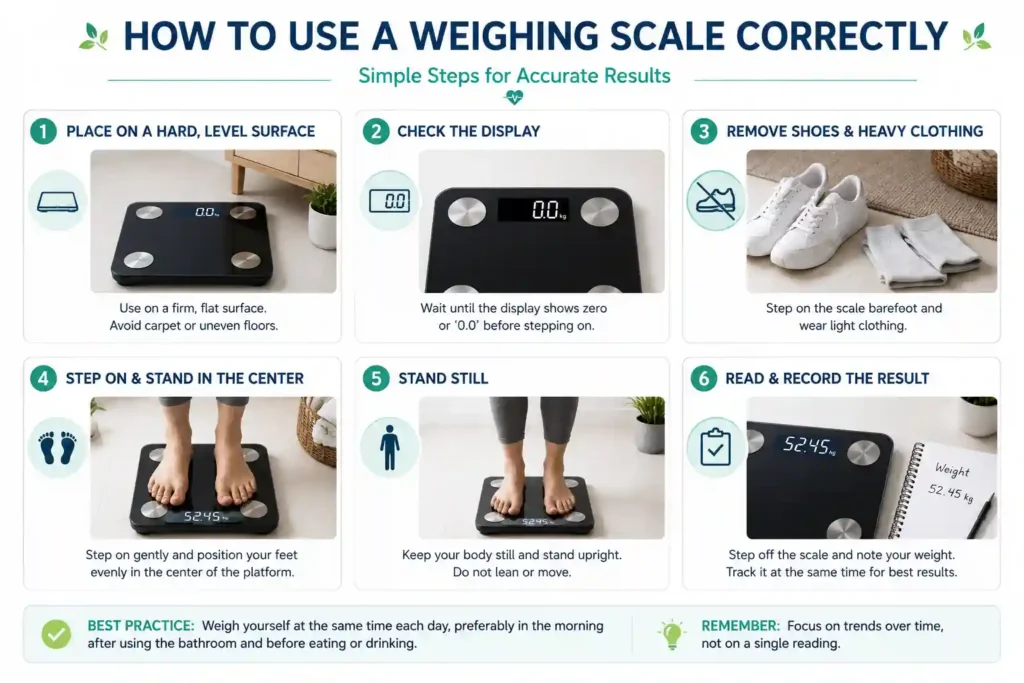
Follow these steps.
Step 1: Place the Scale on a Hard, Level Surface
Place the scale on a firm, flat floor.
Avoid soft surfaces such as:
- Carpet
- Rugs
- Uneven flooring
- Cushioned mats
A hard, stable surface generally provides more consistent measurements.
Step 2: Check the Display
If you are using a digital scale, allow it to initialize according to the manufacturer’s instructions.
Some models require the display to return to zero before weighing.
Step 3: Remove Shoes and Heavy Clothing
For routine weight monitoring, weigh yourself without shoes and ideally with similar clothing each time.
Heavy clothing can affect the measurement.
Step 4: Stand in the Center
Step onto the scale carefully.
Place your feet approximately evenly on the platform.
Avoid standing on the edge.
Step 5: Stand Still
Remain still while the scale measures your weight.
Do not lean forward, backward, or sideways.
Step 6: Record the Result
Record your weight if you are monitoring it over time.
You can use:
- A notebook
- Smartphone notes
- A health-tracking app
- A spreadsheet
- The scale’s companion application
What Is the Best Time to Weigh Yourself?
There is no single universally required time for everyone.
However, if you want to compare measurements consistently, choose a routine that can be repeated under similar conditions.
Many people find it convenient to weigh themselves in the morning after using the bathroom and before eating or drinking.
The important principle is consistency.
For example:
Monday morning: before breakfast
Tuesday morning: before breakfast
Wednesday morning: before breakfast
This provides more comparable measurements than weighing at completely different times under different conditions.
Why Does My Weight Change Every Day?
Daily fluctuations are normal.
Seeing your weight increase by several hundred grams does not necessarily mean you gained body fat.
For example, eating a salty meal may temporarily increase water retention.
Likewise, consuming more food or fluid means there is simply more mass in your body until it is processed and eliminated.
Other factors include:
- Hydration
- Sodium intake
- Carbohydrate intake
- Exercise
- Sleep
- Hormonal changes
- Bowel movements
- Time of measurement
Instead of becoming concerned about one reading, look at the overall trend.
How Accurate Are Home Weighing Scales?
Home scales can be useful for monitoring weight, but their readings may vary.
Accuracy can be affected by:
- Scale quality
- Surface underneath the scale
- Battery condition
- Calibration
- User position
- Movement
- Temperature and environmental conditions
- Maximum weight capacity
- Wear and damage
Professional measurement environments use standardized procedures and equipment. CDC measurement procedures, for example, specify placing the scale on the floor, ensuring the display is at zero, having the person remove shoes and outer clothing, stand centrally, remain still, and recording the displayed weight.
How to Check Whether Your Weighing Scale Is Working Properly
If your scale suddenly gives unusual readings, don’t immediately assume your body weight changed.
Try these checks:
1. Check the Floor
Make sure the scale is on a hard, level surface.
2. Replace the Batteries
Weak batteries may cause unreliable operation in some digital scales.
3. Recheck Your Position
Stand still and centered.
4. Repeat the Measurement
Step off the scale and wait according to the manufacturer’s instructions before repeating the measurement.
5. Test With a Known Weight
If appropriate, you can test the scale with an object whose weight is reliably known.
Do not use an unsafe or excessively heavy object.
6. Check the Manufacturer’s Instructions
Different scales have different reset, calibration, and initialization procedures.
Common Mistakes When Using a Weighing Scale
Mistake 1: Using the Scale on Carpet
Soft surfaces can affect readings.
Better: Use a firm, level floor.
Mistake 2: Weighing at Random Times
A morning measurement and an evening measurement may naturally differ.
Better: Establish a consistent routine.
Mistake 3: Wearing Heavy Clothing
Shoes, jackets, and heavy clothing add weight.
Better: Use similar clothing conditions for comparable readings.
Mistake 4: Moving While Being Weighed
Movement can interfere with the measurement.
Better: Stand still.
Mistake 5: Looking Only at One Reading
One measurement doesn’t tell the whole story.
Better: Look at trends over time.
Mistake 6: Assuming Smart Scale Numbers Are Medical Diagnoses
Smart scales may estimate body composition using bioelectrical impedance or other technologies.
These estimates can be influenced by hydration and other factors.
Better: Use these features as tracking information rather than treating them as definitive medical measurements.
Weighing Scale and BMI: Are They the Same Thing?
No.
A weighing scale measures weight.
BMI, or Body Mass Index, uses both weight and height.
The standard BMI formula is:
BMI = weight in kilograms ÷ height in meters²
For example, if someone weighs 70 kg and is 1.75 m tall:
BMI = 70 ÷ (1.75 × 1.75)
BMI can be useful as a screening measure, but it does not directly measure body fat. The CDC describes BMI as a measure of weight adjusted for height and notes that it is a surrogate measure rather than a direct measurement of body fat.
Therefore, a weighing scale and BMI calculator provide different types of information.
Can a Weighing Scale Tell If You Are Healthy?
Not by itself.
Body weight is only one part of health.
Two people can have the same weight but very different:
- Heights
- Body compositions
- Muscle mass
- Waist circumferences
- Fitness levels
- Medical histories
- Metabolic health
Likewise, a person’s weight can change because of many different reasons.
If you notice an unexplained or significant change in weight, especially when accompanied by other symptoms, it is sensible to discuss it with a healthcare professional.
Who Should Monitor Weight Regularly?
Regular weight monitoring may be particularly useful when recommended by a healthcare professional.
It may also be useful for people who are:
- Managing a weight-loss goal
- Working toward healthy weight gain
- Following a structured nutrition plan
- Monitoring lifestyle changes
- Tracking progress during an exercise program
However, frequent weighing is not appropriate or helpful for everyone.
If checking your weight causes significant anxiety, distress, or unhealthy behaviors, consider discussing an appropriate monitoring approach with a qualified healthcare professional.
Weighing Scale for Older Adults
Older adults may benefit from weight monitoring in some circumstances, but safety is important.
A scale should:
- Have a stable platform
- Be positioned on a firm surface
- Have an easy-to-read display
- Be placed somewhere with adequate lighting
- Be easy to step onto safely
If someone has difficulty with balance, stepping onto a conventional bathroom scale without assistance may create a fall risk.
In such situations, ask a healthcare professional or caregiver about safer ways to monitor weight.
Weighing Scale for Children
Children should not be evaluated using adult weight standards alone.
A child’s weight needs to be interpreted in relation to factors such as:
- Age
- Sex
- Height
- Growth pattern
- Development
- Overall health
For children, growth charts and pediatric assessment are generally more informative than simply looking at the number displayed on a home scale.
Parents should avoid making a child feel ashamed or anxious about their weight.
How Often Should You Weigh Yourself?
The appropriate frequency depends on your goal.
Some people may prefer:
- Daily monitoring
- Several times per week
- Weekly monitoring
- Occasional monitoring
For general lifestyle tracking, consistency is usually more useful than repeatedly checking throughout the day.
If a healthcare professional has recommended a specific weighing schedule, follow that advice.
How to Clean and Maintain a Weighing Scale
Keeping your scale clean can help maintain hygiene and extend its useful life.
Basic maintenance tips:
- Wipe the surface using a suitable slightly damp cloth.
- Follow the manufacturer’s cleaning instructions.
- Avoid immersing an electronic scale in water.
- Keep the battery compartment dry.
- Store the scale in a safe location.
- Avoid dropping or striking the scale.
- Check batteries periodically.
- Do not exceed the maximum weight capacity.
Never use harsh cleaning chemicals unless the manufacturer specifically says they are suitable.
When Should You Replace a Weighing Scale?
Consider replacing a scale if:
- The display repeatedly malfunctions
- Measurements are consistently inconsistent
- The platform is cracked
- Sensors appear damaged
- Buttons no longer work correctly
- The scale repeatedly shows error messages
- The battery compartment is damaged
- The device has exceeded its useful life
If a scale becomes physically damaged, don’t continue using it if doing so could create a safety risk.
Should You Buy a Cheap or Expensive Weighing Scale?
Price alone doesn’t determine whether a weighing scale is suitable.
A basic model may be completely adequate if your primary requirement is:
“I just want to know my body weight.”
A more expensive smart model may be worthwhile if you specifically want:
- Smartphone integration
- Multiple profiles
- Weight history
- Automated tracking
- Additional estimated measurements
The best scale is the one that is appropriate for your needs, easy to use, and consistently maintained.
Buying Checklist: What to Look for in a Weighing Scale
Before purchasing, check:
- Maximum weight capacity
- Display readability
- Measurement units
- Platform size
- Stability
- Accuracy specifications
- Battery type
- Warranty
- User reviews
- App compatibility, if applicable
- Privacy/data practices for connected smart scales
- Manufacturer reputation
Quick Recommendation
For basic weight tracking: Choose a reliable digital scale.
For technology enthusiasts: Consider a smart scale.
For users requiring higher capacity: Select a model specifically designed for the required weight range.
For children: Use an age-appropriate pediatric scale when needed.
Affiliate Product Recommendations
If you are looking for a weighing scale for home use, you can compare different models based on your requirements rather than simply choosing the most expensive option.
Recommended categories to include in your product section:
1. Best Budget Digital Weighing Scale
CHECK CURRENT PRICE —
2. Best Smart Weighing Scale
CHECK CURRENT PRICE —
3. Best High-Capacity Weighing Scale
CHECK CURRENT PRICE —
4. Best Children’s Weighing Scale
CHECK CURRENT PRICE —
5. Best Weighing Scale With Large Display
CHECK CURRENT PRICE —
6. Best Weighing Scale With App Tracking
CHECK CURRENT PRICE —
Frequently Asked Questions About Weighing Scales
1. What is a weighing scale used for?
A weighing scale is used to measure body weight. Home scales are commonly used for personal weight monitoring.
2. Which weighing scale is best for home use?
For most people, a reliable digital weighing scale with a suitable weight capacity, stable platform, clear display, and good manufacturer support is sufficient.
3. Are digital weighing scales accurate?
Digital weighing scales can provide useful weight measurements, but readings can be affected by the surface, positioning, batteries, calibration, and other factors. Consistent measurement conditions are important.
4. Should I weigh myself every day?
Not necessarily. Some people prefer daily tracking, while others prefer weekly or occasional measurements. The best frequency depends on your goals and circumstances.
5. Why does my weight change every day?
Daily weight can fluctuate because of fluid, food, salt, carbohydrates, bowel movements, exercise, hormones, and the time of measurement.
6. Should I weigh myself before or after eating?
For more consistent comparisons, many people choose to weigh themselves before eating or drinking, often in the morning. The key is to use similar conditions each time.
7. Can I use a weighing scale on carpet?
A weighing scale is generally better used on a firm, level surface. Carpet can interfere with consistent measurements.
8. Are smart weighing scales accurate?
Smart scales can be useful for tracking weight and trends. However, additional body-composition measurements are estimates and should not automatically be considered diagnostic measurements.
9. Does weighing scale measure body fat?
A basic weighing scale measures body weight, not body fat. Some smart scales estimate body composition, but these estimates are not the same as direct clinical measurements.
10. What is the difference between a weighing machine and weighing scale?
In everyday language, “weighing machine,” “weighing scale,” “weight machine,” and “bathroom scale” can all refer to a device used to measure body weight.
11. Can a weighing scale calculate BMI?
Some smart or digital scales calculate BMI when height information is entered. BMI can also be calculated separately using weight and height.
12. Why does my weighing scale show different readings?
Different readings can occur because of changes in body position, floor surface, battery condition, scale initialization, time of measurement, or actual changes in body weight.
13. How do I make my weighing scale more accurate?
Use it on a hard, level surface, follow the manufacturer’s instructions, ensure it is properly initialized, stand centrally and still, and maintain consistent measurement conditions.
14. How long does a digital weighing scale last?
Lifespan varies depending on build quality, usage, environment, and maintenance. Replace a scale when it becomes unreliable, damaged, or unsafe.
15. What is the best way to use a weighing scale at home?
For consistent home weight measurements, place the weighing scale on a hard, level surface, remove shoes and heavy clothing, stand centered on the platform, remain still while the measurement is taken, and try to weigh yourself at a similar time and under similar conditions each time. Focus on weight trends rather than individual daily fluctuations.
Important Health Disclaimer
This article is intended for general educational and informational purposes only.
A weighing scale is a monitoring device and should not be used by itself to diagnose a medical condition.
Weight changes can have many possible causes. If you experience unexplained, rapid, persistent, or concerning changes in weight, or if weight changes occur with other symptoms, consult a qualified healthcare professional.
Do not make major changes to your diet, medication, or treatment plan solely because of a weighing-scale reading.
Final Takeaway
A weighing scale may look like a simple device, but using it correctly can make a major difference in the usefulness of the information it provides.
For most people, you don’t need the most expensive model. A reliable digital weighing scale with an appropriate weight capacity, stable platform, clear display, and consistent measurement performance can be enough for routine home monitoring.
Remember these five rules:
Hard, level surface.
Similar conditions every time.
Stand still and centered.
Focus on trends rather than one reading.
Don’t interpret weight alone as a complete picture of health.
And if you’re considering buying a weighing scale, choose one based on your actual needs—not simply the number of features advertised on the box.
Read also – Digital Thermometer: Types, Uses, Accuracy, Buying Guide & Best Picks.