
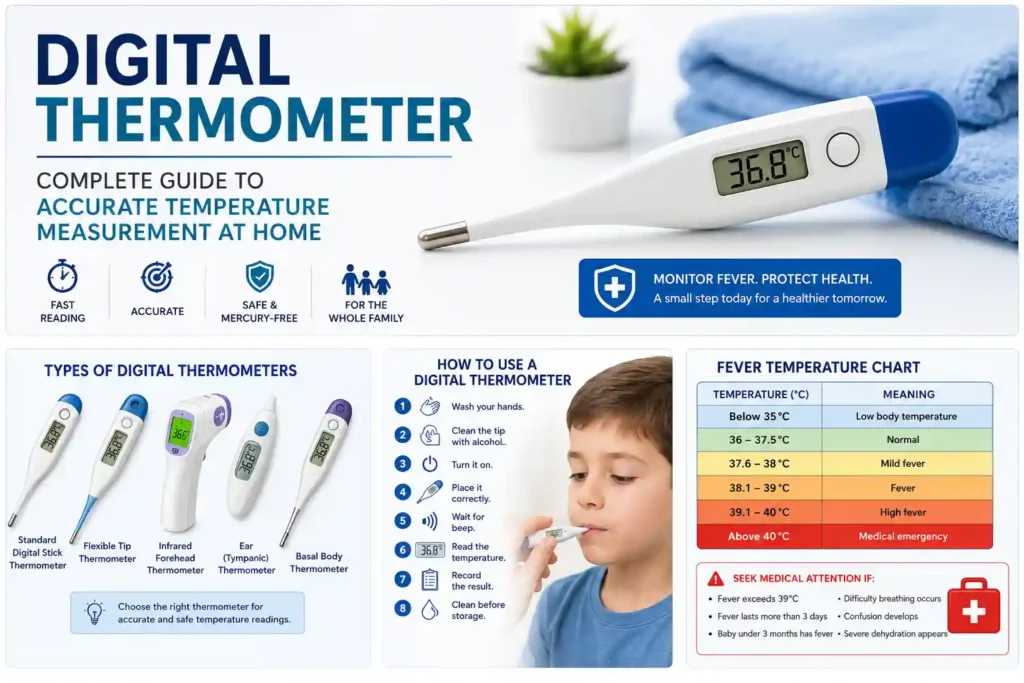
Digital Thermometer: Complete Guide to Accurate Temperature Measurement at Home
एक digital thermometer is one of the most important medical devices every home should have. Whether you’re checking a child’s fever, monitoring recovery from illness, or caring for elderly family members, a reliable thermometer helps you make informed healthcare decisions quickly.
Unlike traditional mercury thermometers, digital thermometers provide fast, accurate, and safe temperature readings without the risk of mercury exposure. Most modern models display results within 10–60 seconds, making them ideal for home, clinic, school, and travel use.
In this comprehensive guide, you’ll learn everything about digital thermometers, including how they work, different types, proper usage, fever temperature ranges, cleaning methods, buying tips, common mistakes, frequently asked questions, and recommendations for choosing the best device.
विषयसूची
What is a Digital Thermometer?
A digital thermometer is an electronic medical device that measures body temperature using an electronic heat sensor. The temperature is displayed on an LCD screen in either Celsius (°C) or Fahrenheit (°F).
Unlike mercury thermometers, digital models are:
- Mercury-free
- Easy to read
- Faster
- Safer for children
- More hygienic
- Portable
- Affordable
Most digital thermometers are suitable for:
- Adults
- Children
- Babies
- Elderly patients
How Does a Digital Thermometer Work?
Digital thermometers use a thermistor, a temperature-sensitive electronic resistor.
As body temperature changes:
- Electrical resistance changes.
- The thermometer processes the data.
- Internal software calculates temperature.
- Result appears on the LCD display.
Most models beep when measurement is complete.
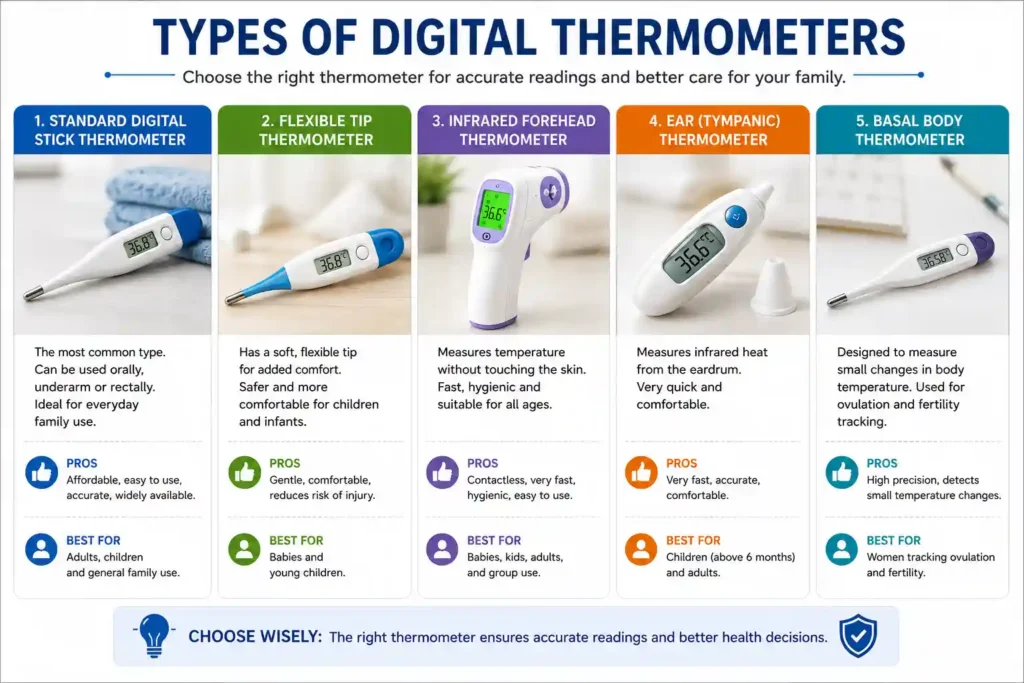
Types of Digital Thermometers
1. Standard Digital Stick Thermometer
The most common type.
Can be used:
- मुंह में
- Underarm
- Rectal
Ideal for families.
2. Flexible Tip Thermometer
Features:
- Soft flexible tip
- Comfortable
- Better for children
- Safer for infants
3. Infrared Forehead Thermometer
Measures temperature without touching the skin.
Advantages:
- Very fast
- Hygienic
- Suitable for babies
- Great for hospitals
4. Ear (Tympanic) Thermometer
Measures heat from the eardrum.
Pros:
- Very quick
- Comfortable
- Good for children over 6 months
5. Basal Body Thermometer
Designed for:
- Ovulation tracking
- Fertility monitoring
Measures very small temperature changes.
Benefits of Digital Thermometers
✔ Fast readings
✔ Accurate measurements
✔ Mercury-free
✔ Safe for children
✔ Lightweight
✔ Portable
✔ Easy-to-read display
✔ Battery operated
✔ Automatic shut-off
✔ Fever alarm
✔ Memory recall
✔ Waterproof options available
Who Should Keep a Digital Thermometer at Home?
Every household should own one, especially if there are:
- Infants
- Young children
- Pregnant women
- Elderly people
- Individuals with chronic illnesses
- Patients recovering from surgery
- Travelers
- Schools and offices
Normal Body Temperature
Normal body temperature varies depending on age, activity, and the measurement site.
| Measurement Site | Normal Temperature |
|---|---|
| मुंह में | 36.5–37.5°C |
| Underarm | 36.0–37.0°C |
| Rectal | 36.6–38.0°C |
| Ear | 35.8–38.0°C |
Average normal body temperature:
37°C (98.6°F)
Fever Temperature Chart
| Temperature | Meaning |
|---|---|
| Below 35°C | Low body temperature |
| 36–37.5°C | Normal |
| 37.6–38°C | Mild fever |
| 38.1–39°C | Fever |
| 39.1–40°C | High fever |
| Above 40°C | Medical emergency |
Seek medical attention if:
- Fever exceeds 39°C
- Fever lasts more than 3 days
- Baby under 3 months has fever
- Difficulty breathing occurs
- Confusion develops
- Severe dehydration appears
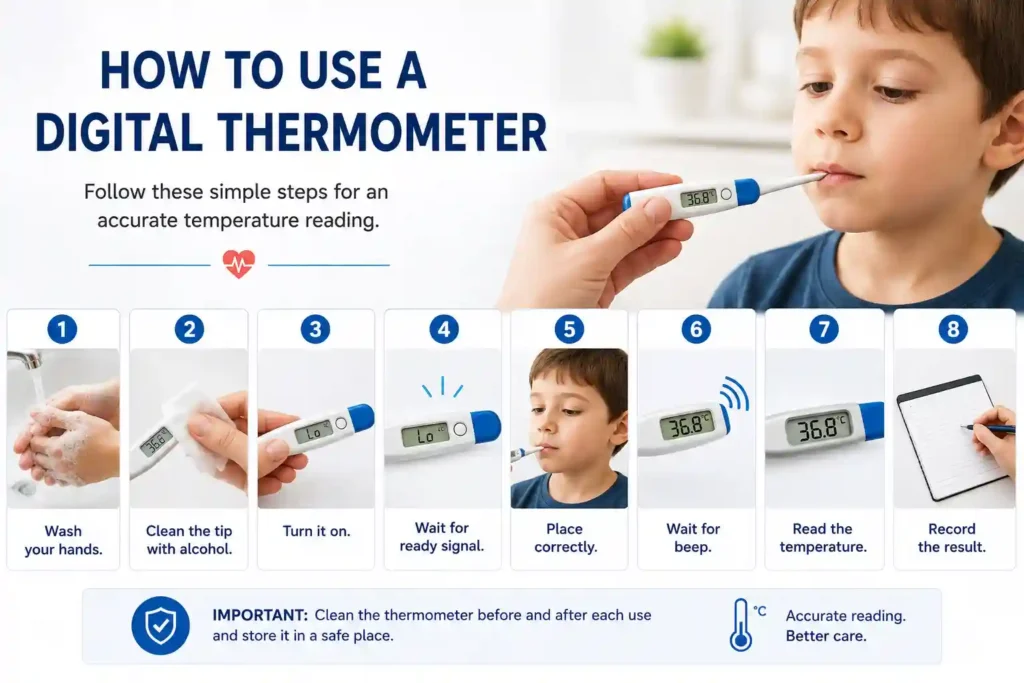
How to Use a Digital Thermometer Correctly
Follow these steps:
- Wash your hands.
- Clean the thermometer tip with alcohol.
- Turn it on.
- Wait for ready signal.
- Place correctly.
- Wait for beep.
- Read temperature.
- Record the result.
- Clean before storage.
Oral Temperature Measurement
Best for:
- Adults
- Older children
Steps:
- Place under the tongue.
- Close mouth.
- Wait until beep.
- Read temperature.
Avoid:
- Eating for 15 minutes before testing.
- Drinking hot or cold beverages.
- Smoking.
Underarm Temperature
Suitable for:
- Babies
- Children
- Adults
Steps:
- Dry armpit.
- Place thermometer.
- Hold arm tightly.
- Wait until beep.
May read about 0.5°C lower than oral temperature.
Rectal Temperature
Most accurate for:
- Infants
Steps:
- Apply lubricant.
- Insert gently (1–2 cm for infants).
- Hold still.
- Wait until beep.
- Clean thoroughly.
Use a separate thermometer for rectal measurements if possible.
Caring for Babies
For newborns:
Rectal temperature is generally the most accurate.
For older infants:
- Underarm
- Forehead
- Ear (after 6 months)
Always consult a healthcare provider if:
- Baby is younger than 3 months and has a fever.
- Baby appears unusually sleepy or difficult to wake.
- Fever is persistent or accompanied by other concerning symptoms.
Cleaning and Maintenance
Clean after every use.
Recommended cleaning:
- 70% isopropyl alcohol
- Soap and water (waterproof models)
- Soft cloth
Avoid:
- Boiling
- Microwave sterilization
- Harsh chemicals
- Abrasive cleaners
Replace batteries when the low-battery indicator appears.
Store in its protective case away from heat and moisture.
Common Mistakes
Many inaccurate readings happen because of improper technique.
Avoid these mistakes:
- Measuring immediately after exercise.
- Taking a reading right after hot or cold drinks.
- Not waiting for the completion beep.
- Placing the thermometer incorrectly.
- Using a dirty thermometer.
- Ignoring the battery level.
- Storing it in extreme temperatures.
Buying Guide
When choosing a digital thermometer, consider the following features:
- Accuracy: Look for models with an accuracy of ±0.1°C.
- Fast Response: Readings within 10–30 seconds are convenient.
- Large Display: Easier to read, especially for seniors.
- Memory Recall: Helpful for tracking fever trends.
- Fever Alarm: Audible alert for elevated temperatures.
- Flexible Tip: More comfortable for children.
- Waterproof Design: Easier to clean.
- Automatic Shut-Off: Saves battery life.
- Battery Availability: Uses common button-cell batteries for easy replacement.
- Warranty: Indicates manufacturer confidence in product quality.
Affiliate Recommendations
If you’re planning to purchase a digital thermometer, consider models that offer clinical-grade accuracy, durable construction, and trusted customer reviews.
Recommended categories include:
- Standard digital stick thermometers for everyday home use.
- Flexible-tip thermometers for babies and young children.
- Waterproof thermometers for easier cleaning.
- Infrared forehead thermometers for contact-free measurements.
- Ear thermometers for quick readings in older infants and adults.
Affiliate Disclosure:
This page may contain affiliate links. If you purchase through these links, we may earn a small commission at no extra cost to you. This helps support our website and allows us to continue creating free, evidence-based health content.
- 🛒 Check Today’s Best Price on Amazon
- 🛒 Compare Top Digital Thermometers
- 🛒 View Best Deals for Family Thermometers
- 🛒 Buy Clinically Accurate Digital Thermometers
Digital Thermometer vs Mercury Thermometer
| Feature | Digital Thermometer | Mercury Thermometer |
|---|---|---|
| Speed | 10–60 seconds | 3–5 minutes |
| सुरक्षा | Mercury-free | Contains mercury |
| Display | LCD screen | Glass scale |
| Ease of Use | Very easy | Requires careful reading |
| Suitable for Children | Yes | Less suitable |
| Durability | Good | Fragile |
| Environmental Risk | Low | High if broken |
For most households, a digital thermometer is the preferred choice due to its safety and convenience.
अक्सर पूछे जाने वाले प्रश्न (FAQs)
Is a digital thermometer accurate?
Yes. Quality digital thermometers are highly accurate when used according to the manufacturer’s instructions.
Which temperature measurement method is most accurate?
Rectal measurements are generally considered the most accurate for infants, while oral measurements are commonly used for older children and adults.
Can I use one thermometer for oral and rectal measurements?
It’s best to use separate thermometers or clearly label them to avoid cross-contamination.
How often should I replace the battery?
Replace the battery when the low-battery symbol appears or if readings become unreliable.
Why are my readings different each time?
Small variations can occur due to the measurement site, recent eating or drinking, physical activity, and incorrect placement.
Can digital thermometers get wet?
Many are water-resistant or waterproof, but always check the manufacturer’s specifications before rinsing or immersing the device.
How should I store my thermometer?
Store it in a protective case in a cool, dry place away from direct sunlight and extreme temperatures.
Safety Tips
- Do not share thermometers without cleaning them thoroughly.
- Keep out of reach of young children when not in use.
- Never use a damaged thermometer.
- Follow the manufacturer’s instructions for cleaning and battery replacement.
- Seek medical advice for persistent high fever or concerning symptoms.
अंतिम विचार
A digital thermometer is an essential tool for every home. Its speed, accuracy, ease of use, and mercury-free design make it a safer and more convenient choice than traditional thermometers. By learning the correct measurement techniques, maintaining the device properly, and understanding normal temperature ranges, you can confidently monitor your family’s health.
Whether you’re caring for a newborn, managing an illness, or simply keeping a well-stocked home first-aid kit, investing in a high-quality digital thermometer is a practical decision that supports timely and informed healthcare.
यह भी पढ़ें – Comprehensive Primary Care: The Ultimate Guide to Total Health Management.